

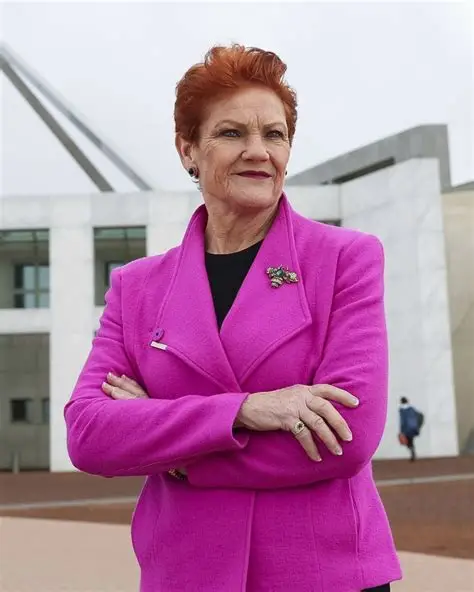
In the polished corridors of Canberra, where political discourse has long been a genteel affair of scripted barbs and comfortable consensus, Pauline Hanson moves like a thunderclap. Unpolished, unrelenting, and unapologetic, she and her One Nation Party have shattered the decorum of Australia’s established order.
For nearly three decades, a growing segment of the Australian public, those who feel the sharp edge of neglect, has found in her a raw, visceral voice. Like Donald Trump before her, Hanson channels a potent brew of frustration, distrust, and defiance. Her style may lack refinement, but its resonance is undeniable among those who believe the nation’s institutions have quietly abandoned them.
The grievances are neither trivial nor imagined. Uncontrolled migration has strained social cohesion and infrastructure. Identity politics has fractured the shared sense of nationhood. The legal system, from magistrates’ courts to the High Court, stands tarnished by scandals and perceived partiality. Successive governments, Labor and Liberal alike, have presided over these failures with a mixture of indifference and incompetence.
The economy, once the reliable “bone to the dog” offered by the major parties, no longer soothes. Official unemployment figures are viewed with skepticism, shaped by creative accounting from the Reserve Bank. The Australian dollar, operating under a managed float, is suspected of deliberate manipulation to justify punishing interest rate hikes that crush small businesses and mortgage holders. Even basic national resilience, strategic fuel reserves of the kind smaller, wiser nations like Singapore maintain, has been neglected, leaving Australia vulnerable to global shocks.
These pressures have driven a quiet but seismic realignment. Defections from the major parties to One Nation have accelerated, fueled by visible discontent and, yes, the considerable financial patronage of mining magnate Gina Rinehart. Self-serving polls, funded and amplified by interested parties, now float the provocative notion that One Nation could emerge as the preferred party in a hypothetical election. Whether or not such surveys overstate the shift, the underlying discontent is real.
Parliament itself has become a theatre of the absurd: a stage for performative outrage, personal insults, and cameo appearances while the nation smolders. The major parties’ attempts to stem the bleeding have often only deepened public cynicism. The Liberals’ rehabilitation of faded figures, Alexander Downer with his affected accent and patrician air, or Tony Abbott, whose history includes controversial financial arrangements involving Chinese donors and substantial, poorly disclosed contributions linked to the Clinton Foundation, has done little to restore faith. Labor’s multi-billion-dollar commitments to domestic violence initiatives, framed in ways that appear to prioritize certain lobbies while sidelining male and child victims, have similarly invited accusations of ideological capture rather than genuine governance.
Hanson has seized this moment of institutional decay. She is the brick wall, the hard, unforgiving convergence of decades of failed policies, that Australia may need to crash into before it can regain its bearings. In her rise lies an indictment of the complacency that preceded it.
Yet this is no simple morality tale. For all her ability to articulate the raw anger of the disaffected, Hanson and One Nation possess profound limitations. She lacks the intellectual depth, the diplomatic finesse, and the commanding grasp of international relations required to navigate Australia’s precarious position in a fracturing world. Her party shows few signs of possessing the sophisticated cadres needed to manage complex relationships with Australia’s two most consequential neighbours, India and China, or to chart a credible course through the treacherous waters of energy security, defence strategy, and economic sovereignty. The colonial-era architecture of Australia’s military alliances, long overdue for honest reappraisal, demands statesmanship of a higher order than Hanson has demonstrated.
As the next federal election approaches, Australia stands at a dangerous crossroads. The major parties’ long complacency has created the conditions for One Nation’s ascent. Should that ascent continue unchecked by serious reform from the centre, the nation risks emerging more divided, more unstable, and more volatile than at any time in its modern history.
The Hanson phenomenon is not merely a political curiosity, it is a warning. Australia does not need mere protest; it needs radical, intelligent, and courageous renewal across both domestic and foreign policy. Whether that renewal comes from within the existing order or demands something far more disruptive remains the urgent question of our time.
The storm has arrived. The only certainty is that the comfortable consensus of old Canberra cannot withstand it.
Ravindran Nair
